Friday, March 29, 2019

Final Project Idea

Final Project Idea:

One look can determine an impression. What determines how we think? What determines our view on someones image? How can you judge someone based on looks?
Our final project idea looks at the politics of image. How people present themselves or come across through first impressions are crucial in defining who they are to society.

Our test will be taking average, everyday people who define themselves under a certain identity. We will have people in everyday society judge them based on a single photo. We will be using side-by-side photos of different people and ask the public a number of questions related to these photos. We will be able to get a look into how people think and judge others.

We liked the idea (below) of a tally mark or a tick under each photo as this is quite powerful. We got this inspiration from Marilyn Monroe photoshoot tactics. We will be creating a sheet of all of the side-by-side photos with the questions above them and have people cross out one person or the other.
We are still gathering ideas on where we would be able to do this. (suggestions from class?)
Will they be able to tell people apart based on their beliefs/values?


Who voted Brexit?


After gathering results we will upload them with the final project.


Sample questions:
“Who would you trust?”
“What is your initial emotion when seeing this person?”
“Who is a conservative?”
“Who is an international student?”
“Who is… (Occupation)?”
“Who is a parent?”

Photos of my sister..

I took some photos of my sister, Katie, wearing the different types of clothes she typically wears day to day.
The first photo shows how she would dress when she's staying at home and doing nothing, or nipping down to tesco to get food shopping, generally not worrying about how she appears (though I still think she looks lovely)
The second photo is how she dresses to go to college. She goes to a typical arty college in Brighton where people put quite a lot of emphasis on their day to day outfits, and everyone wants to express themselves through how they dress (influenced by their favourite instagrammers of course)
Finally, in the third photo, she's dressed how she would for weekly dance lessons or other forms of exercise. She doesn't do as much dance as she used to but she grew up as a ballet and tap dancer, and it's always been part of her life and identity.


Here's two great guys Phil and Charlie, who look similar and are wearing the same colour T-Shirts (which is just a coincidence btw). The are both doing the same job - Brewing beer - how cool is that??? 
Both are British in their late 20s. 

But there is one aspect that distinguishes them from each other... 

One of them voted Brexit. Can you tell who it was?

Research: Santigo Sierra

Santigo Sierra's provocative art work has often evoked feelings of repulsion due to the somewhat distasteful manner in which he conducts his pieces, however this is not in vain, but actually an exhibition of a very real dilemma currently existing in society. The image below displays how Sierra paid four drug addicts in heroin to have a line tattooed on their back. In this case, art, in a overt exploitative way intervened quite personally in their everyday life, magnifying the ailments of the much larger capitalist system which, in the same way, affects us just as much. 

“The tattoo is not the problem. The problem is the existence of social conditions that allow me to make this work.”

Whilst the people chosen acted out of their own volition it, nevertheless, demonstrates how the system can break a person down to the point where they are ready to offer their bodies as a sacrifice for dose of a substance which will ultimately keep them in bondage to the system. 

What draws me to this piece is the vulnerability of the person, the permanence of the tattoo, the bodily sacrifice and how it's nature is explicitly interventionist. By choosing the often ignored and disregarded in society and putting them on a warped pedestal, the innocent bystander becomes not so innocent in their active lack of participation with a quite apparent abuse of power. Sierra calls us to wake up and pay attention to the abusive nature of the system, and how we are all permanent participants in different ways. 

In this way image becomes political, when it encapsulates a message and motivates a people. It inspires me to create an image that will capture the essence of a political statement as beautifully as Sierra. That the image will capture a moment in time where an intervention took place and spoke volumes through an intricate and potentially violent but necessary unpacking 
of the every day life. 

Image result for santiago sierra tattoo
Santigo Sierra 160cm line tattoo

Development

Politics of image:

Edward Said’s orientalism perfectly depicts how the relationship between image and politics is inextricably linked.
Through Said we explore how these racist themes still exist today. By understanding the way the west creates these narratives all the way from racist fantasies to shaping a recognisable antagonist.
 There is a particular type of history which carries with it a racist tone, which even lies in science. Orientalist attitudes, tied with the Foucaudian idea of regimes of truth – normalising power
The winners write history, and they will always script it in their favour
·         Understanding the relationship between aesthetics, representation power and discourse
·         Controversial as it expanded the net of what racism actually extends to
·         Academic: anyone who teaches, writes about, researches the orient is and Orientalist despite their good intentions
·       Style of thought: Oriental based on a difference of being (ontological) as well as a difference of knowledge (epistemological) between the orient and the occident (the west).
·         Institution: Orientalism is a western style for dominating, restructuring, and having authority over the west. For example the UN
·         There is a link between knowledge and power
·         Foucault: Not interested in power as a commodity (that someone uses) but rather as a network that is intimately linked to knowledge, institutions, and subject positions
·         For example: It is not that a doctor is powerful but rather the weight that medical knowledge holds

The politics of image becomes the politics of the mindset
Images so overt, so visible, so loud yet so invisible and hidden and opaque in its motivations
Exploring the politicization of the relationship between the visible image and the invisible message
Not just exploring the negative but also the positive – they are equally orientalist

Thursday, March 28, 2019

Joes Segal on the politics of images

In this TEDx Talks, Joes Segal, Professor of cultural history at the University of Utrecht, gives a sort of an overview of what can be said on the politics of images.  Here, the politics of images represent simply the political impact of any kind of images created.


Segal poses a few questions that, according to him, are crucial to consider : 
What are our initial reaction when we see an image? why and how does it intrigue us? Why it has the ablilty to shock us and when does it shock us? and finally, what is the political relevance of this shock? 

This video of 15 minutes is extremely relevant for how we can approach images in accordance with what artists are really trying to say and the different context in which those images are put. However, I let you watch it to find out more as the content is actually solid and interesting. 

The strangeness of the everyday


Transfiguration gives a different meaning to the notion of life, offering captivating, disturbing, moving insights into the possibility and unpredictabilities of who we really are. ‘Disfigurement in art is a way to bring us face to face with real life’ 

Olivier de Sagazan


Boundaries and perspectives

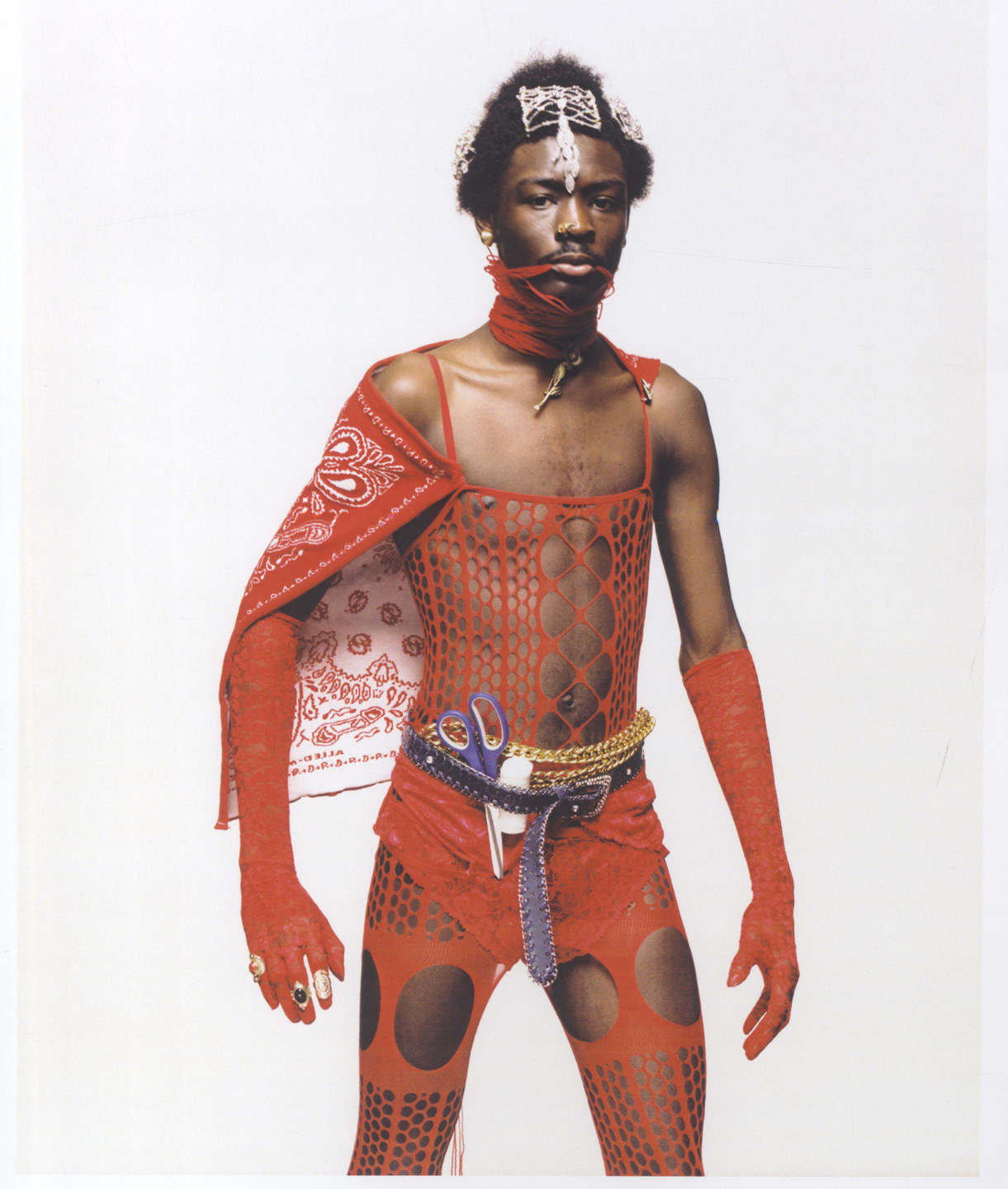
Upon research gathered from Edward Said, image is a very bold medium in which messages are delivered and ideas are reinforced. Gender, stereotypes and normality is constantly being questioned and redefined in the 21st century particularly through fashion. Whilst fashion is an arguably cliche route I believe there is something quite powerful in the manipulation of a garment designed originally designed to fit a particular person. British stylist Ib Kamara refreshingly tackles black masculinity, approaching it from a fresh and tasteful perspective. The role of the black man throughout history is is always been one of a barbarian and a criminal. From the African man oppressed through slavery and made to be nothing more than a mere animal to the 21st century where the stereotype of the "criminal black man" is ever present, it is clear to see that notions of sensitivity are far removed from him. By Kamara choosing to extenuate never seen before attributes of the black male, he attempts to alter the sinister narrative and portray him in a new light. What particularly appeals to me is how the black male is not compromised in the image, there is a strength that pierces through the garments and begins to compliment it. A synergy begins to develop between the two, telling a delicate story of tainted history, strength and reinvention. 

                                                Image result for ib kamara

Monday, March 25, 2019

Trial Run

On Monday we discussed how we would execute a trial run of our intervention and possible questions to ask for final intervention.


  • The questions we came up with were:
  • Who they would trust to look after your child?
  • Who voted Brexit?
  • Who belongs to the LGBTQ community?
  • Who is an immigrant?

These questions were based off of our group rationale and the objectives we were trying to achieve through the intervention. Baring in mind that our rationale explores the politicization of image we chose to ask challenging questions which would force the person to take a clear stance as well as question social and political issues present in today's society. 

We all agreed to take photos and bring them on Thursday's meeting to choose which ones would work for the final intervention. 


Friday, March 22, 2019

What to bring for next week

Firstly, everyone brings 3 questions. Any questions like we could pose with photos of someone's face. For example, "would you trust that person?" or "Would you employ that person?"

Secondly, everyone brings 2 photos of people on a white background. We are trying to get as many diverse pictures as possible for the purpose of the project. Preferably people that you know with their consent.  

Notes

-pictures of people
-ask the public questions?
-ask employers questions?
-could take footage of someone as they react
-circulate the footage - social media?
-have to share the experiment with people
-make decisions about who does what
-locations for photographs

-need something visual for next week
-work out the questions to ask
-6 to 8 people if not more
-variety of people who look different and different ages
-do people trust older people more - people with dreadlocks

Judging America:

Judging America: Photographer Challenges Our Prejudice By Alternating Between Judgment and Reality


Joel Pares, a photographer, captures the stereotypes that everyday Americans face. 

JUDGEMENT VS. REALITY
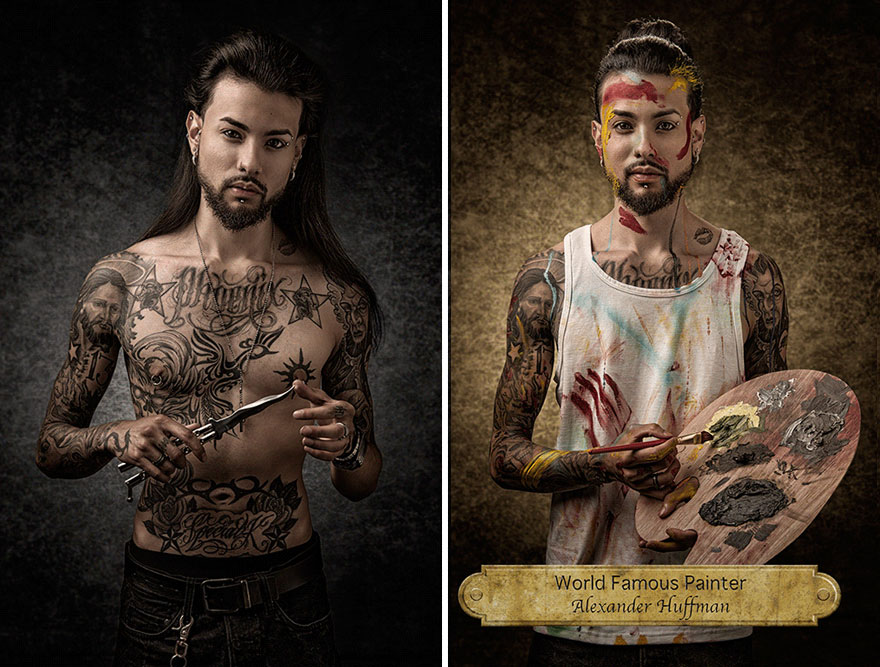
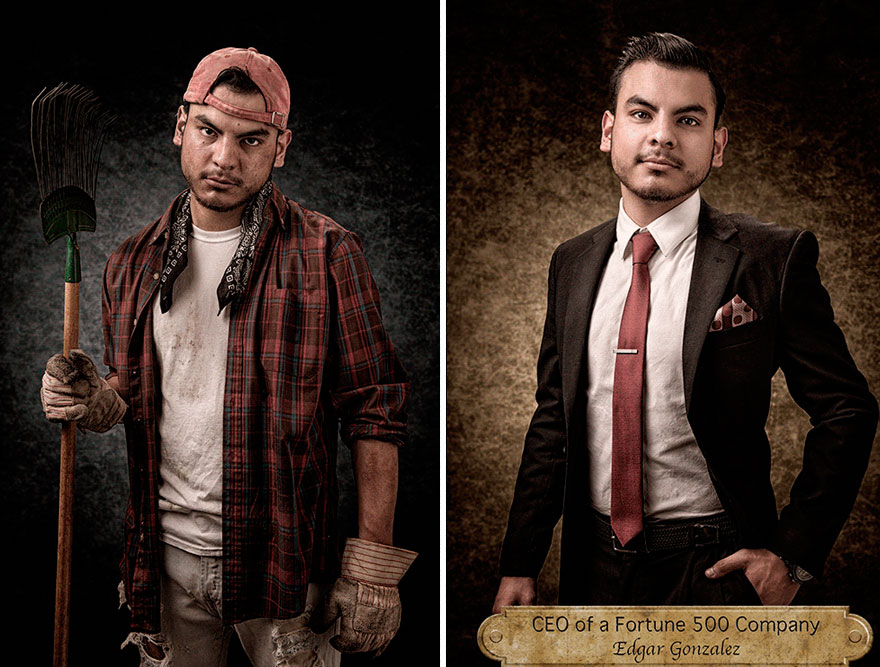
"Pares’ images at first present us with characters symbolic of the prejudices suffered by various groups based on their ethnicity, socio-economic status or sexual preference. Then, however, they show us the real people behind these often false characters – the violent gangster turns out to be a Harvard graduate and an exhausted gardener turns out to be the CEO of a Fortune 500 company.
Many of us judge incorrectly by someone’s ethnicity, by their profession, and by their sexual interest,” Parés told PetaPixel. “The purpose of this series is to open our eyes and make us think twice before judging someone."
prejudice-photo-series-judging-america-joel-pares-9
prejudice-photo-series-judging-america-joel-pares-5
prejudice-photo-series-judging-america-joel-pares-4
I thought we could use this article as a small inspiration for our final project/intervention that we were talking about in class (22/03/2019). 
Our project talked about taking simple photos of two different people and seeing the judgement that they face. We talked about printing out simple photos of people (black background/black and white) and having members of the public tick under which person they choose from a range of questions (such as: "Who would you trust?", "Who has a friendly face?", etc.). We talked about presenting this in a public space (not in Goldsmiths).

Rationale

The examination, evolution and presentation of an acceptable image in the public eye.
 This project is going to see how image is politicized by looking at how people choose to present themselves and the consequences that come from their choices.

Thursday, March 21, 2019

Andrew H Walker

I was reading an article earlier about Lorraine Kelly which was really interesting, it was talking about how someones public self isn't always the private self, maybe it isn't massively relevant but thought I would post it.

https://www.bbc.co.uk/news/entertainment-arts-47638392

In it though it brings up this art project Andrew H Walker where he takes two portraits of famous people, one of how they are in private and public which is really interesting I think. I'll put the link down below, just an interesting idea.

http://www.andrewhwalker.com/

Friday, March 15, 2019

Coats

"How can we trust a woman to run the country whose favourite 'lucky coat' looks like a sleeping bag?" - Janet Street Porter for MailOnline


"Jeremy Corbyn criticised by some for wearing a raincoat as he paid respects at Cenotaph Remembrance Day service" 

Read Lucy's comment on the last post and put in an article about Corbyn wearing the coat he got criticised for last year, and also an article from t a few days ago about Theresa May being criticised for wearing an ugly coat. The article I posted before has a bunch of people they've quoted from different industries and the general consensus from them is that they prefer to have someone dressed in a way that fits that job. But in another article I read it explored the idea that Corbyn had done enexpectedly well in the 2017 General Election could mean conventional wisdom on what a good leader had to behave and dress could be wrong. 

Thursday, March 14, 2019

Priorities? I ain't heard of that!


Another incredibly interesting piece that sparked a fiery debate back in 2017 when the front page of Daily Mail showed Nicola Sturgeon and Theresa May wearing above knee skirts. The opening line is what the majority of the audience found incredible insensitive, sexist and even moronic : "Never mind Brexit, who won Legs-it!".


Even though I personally find the article utterly irrelevant and silly, it is a perfect example of how people fail to prioritise and understand what really matters. Instead, we focus on insignificant things such as clothes, makeup and the overall appearance. Most of us are obsessed with looks even when it comes to people, who basically control our lives and whose decisions have an impact on each and every one of us, the politicians.
 It can, of course, be argued that politicians are always in the public eye hence they have to always look good and presentable but at the same time this is incredibly unimportant. The thing that should matter to people, first and foremost, is how good the politicians are at their job and their contribution towards the welfare and wellbeing of the nation they represent. I would not mind if the President decided to wear sneakers or a t-shirt to a meeting because they are just regular people after all. People, who were elected and entrusted to represent us, ORDINARY PEOPLE.
Hence, I suggest that the attention needs to be paid to the work that the politicians are doing, not the lengths of their skirts/trousers.


the Politics of Image in the Workplace


I found interesting to look at the politics of image into the workplace. We all know that into the workplace we must be professional and respectful towards different kinds of social norms. Nevertheless, what about the image of ourselves? Do we have to behave and adapt our personality in accordance to the place we work? the answer is probably yes but all cases are different.

Here are a few links where we can see that various websites and forums are actually aware of this culture of the "professional image" at work. It is all about  creating a "positive professional image":

https://www.entrepreneur.com/article/247521

http://careerstonegroup.com/blog/70/Five-Tips-for-Creating-a-Positive-Professional-Image


https://woman.thenest.com/importance-image-workplace-2396.html
Those three shorts articles are examples among a very rich range of different writings on the subject. It shows how important it is for people and how they're aware that their personal image can affect their career. 

Another thing about the image in the workplace is the gender distinction. I found this article where there are numerous tips for women to adapt and enhance their image at work. Does a woman have to take care of more her image than a man?

In this other article, the author is even wondering if performance still mater at work at the expense of image.

Sunday, March 10, 2019

The Standards of Image for Female Politicians


I think that the public always expects women to look a certain way, especially when they are involved in politics. However, many people don't realize the differences in criticism that women politicians receive compared to male politicians when it comes to public image.  Male politicians could wear the same suit at every outing and no one could even notice. Women, however, are held to a much higher standard. Is the colour of their pantsuit too bold? Didn't she wear that colour last month? Why is she wearing that and not a skirt? Is her skirt too short? She should have wore a dress, what was she thinking? 
In the video below, the reporter talks about the outfits of Democratic candidate Hillary Clinton's campaign. He talks about the brands, the styles, the colours of her outfits but yet the only thing that he can mention about republican Donald Trumps outfits are his additions of his 'MAGA' hats to his simple suits.
When talking about Hillary Clinton:
"One of my personal favourite outfits has got to be the one where she was nominated as the presidential candidate. She stepped out in a Ralph Lauren and it was white with a littlest of black to it. It was a perfect combination but it was a little bit outside the norm, but also very much like a lady. Hillary Clinton's style throughout the election consisted of just pantsuits. Just the other day at her speech she paired a purple blouse with a black jacket featuring purple satin and matching trousers. We know one thing about this lady, she loves her pantsuits and her favourite designer, Ralph Lauren. She definitely doesn't go shy when it comes to colour."
When talking about Donald Trump:
"Our fashion analysis goes onto our republican nominee and eventual winner, Donald Trump. Just like many men, his wardrobe was limited to suits with the only outstanding feature being the addition of trucker hats."
You can see just on how much more the media focused on the details of Hillary Clinton's outfits compared to Donald Trump.

________________________________________________________________

Margaret Thatcher: Fashion as a Political Tool


"Immaculate hair. Immaculate makeup. In private she was exactly the same as in public. That formality never left, she was extremely professional about her clothes."

"Thatcher was the first prime minister in the UK that was actually media packaged. It was the first time that you had somebody speaking constantly on television, constantly traveling; we had an expectation to the public as a strong prime minister."
______________________________________________________________

Just a final last attachment that I thought was interesting, the evolution of women's fashion in politics:

'100 years of beauty. Women in politics.'


How Tattoos Affect Public Image


Tattoos and Public Treatment


I found these videos on a social experiment and I thought they would be interesting to share. In both of these videos the same social experiment was tried for both a male and a female.
First they stand on the street as themselves (with their tattoos) and ask people for change for £10  or for directions. They are completely ignored or people may seem threatened by them, especially the older generations.
They then tried the same experiment but with their body tattoos completely covered with makeup. People are definitely more responsive.
In the video with the man, the guy he ends up talking to feels extremely threatened by him at the beginning but once he talks to him he realizes that he's just like everyone else.
The Youtube Channel itself - called 'Only Human' - brings up interesting discussion topics and emphasizes the importance of individuality.

I think that tattoos bring up an interesting argument when it comes to a "professional image" in the workplace. As the older generation tends to not be as open to tattoos as the younger generation, large companies run by older generations tend to not be as accepting to tattoos in the workplace as much as companies run by a younger generation do. Obviously there are varying job titles, as a banker wouldn't have as many tattoos are maybe a successful pop-singer, but why should this matter?


In this interview on This Morning, they discuss how tattoos affect job opportunities, specifically for this man. They even ask the woman also present "Would you employ him if he was sitting opposite of you in an interview?" 
"I work in private investigation, and as much as I would like to, you REALLY stand out. He's a lovely young man, I really hope someone does give him a job after seeing this because I do believe you would be really good, but when you have a tattoo in such a prominent place, it's your personal choice. You love it, but we can't expect everyone else to like it." 
She's then asked "Is it not discrimination in some form though? Because so many people have tattoos now." and she then brings up how it's a question of where they draw the line. "We know that tattoos are not readily accepted in society. Nobody accuses a company or a brand when they make them wear a uniform. We have certain standards that we want them to live by. Unfortunately, society does say that tattoos are widely accepted."

Friday, March 8, 2019

https://www.bbc.co.uk/news/business-47466819

An article about peoples opinions on what people wear and their perceptions on them.
I read some information about the EU ruling to allow companies to ban the wearing of religious symbols or garments in the workplace, and this was particularly interesting to see how companies now have the ability to prevent individuals from expressing their individual religion or identity in a 'public' space. While the workplace is technically private space as it is owned by a company, it is public for the people within it, as they are away from their own private sphere and presenting themselves to others. Here are some points I gathered from what I read: 
  
  1. Welcomed by politicians on the Right – the right wing is more opposed to freedom of religious expression 
  2. The rule allows companies the right to ban wearing religious garments in the workplace – whether to do this or not is at the company’s discretion  
  3. Women wearing headscarves could be banned, but only as part of a general policy, banning Christian or other religious symbols too 
  4. Prevents customers of a business from requesting religious symbols to be removed – it must be a policy adopted by the company themselves 
  5. Despite covering all religious symbolism, it seems to particularly focus on Islam, as it comes at a time when ‘Muslim immigration has been a contentious issue.’ 
  6. In the EU religion is highly politicized. The prevalence of terror attacks are fueling Islamophobia across Europe, and some see religious garments such as the Burka as a 'threat to security', which caused protests calling for the garments to be banned. By banning all religious symbolism in the workplace, a company is not discriminating directly against Islam, but Islamophobia could be the motive for companies to adopt the policy, as suggested by the political context.  
  7. France – Francois Fillion, a presidential candidate, claims that the ruling would bring relief to companies and their workers, stating that the ruling would help create ‘social peace’. He is known to disapprove of Islam’s place in France, and these statements suggest that he sees Islam as a threat to social peace, therefore wants to ban signs of it from public space. 
  

Research on Reality TV


(video above: Kim Kardashian 60 Minutes interview – Talks Privacy)

With the topic on the ‘Politics of Space’ and the separation of private and public space I am going to focus on reality television. Reality television brings private space into the public eye, which is why it brings such an interesting connection into the divide of public and private. 
On reality television, I will be focusing on one popular show in particular, Keeping Up with the Kardashians. 
The show Keeping Up with the Kardashians has been following the Kardashian family and filming their every moment since the start of season one in October of 2007. The broadcast company ‘E!’ has been “keeping up” with their lives from the births of new children to cheating scandals for over a decade.  I think that the reason that reality TV is so successful is, because it tends to focus on interesting people, people that are different from everyday society. In the USA, broadcasting companies such as E! TLC and USA (company) make their profits from broadcasting reality TV. The reason that people continue to watch the Kardashians is because the life that we see on TV is a life that may be better than our own. A life full of interesting drama, scandals and wealth. Their lives are commercialised, making the broadcasting company E! bring in millions of dollars per episode and the Kardashian family are fortunate enough to make over $100 million per season just for existing. Just in the past 5 years, Keeping Up with the Kardashians has become extremely popular. The births of new children, the rise of the family on social media and their names always being in the spotlight has drawn new attention to this family and this show in particular. In the video that I attached, it focuses on the announcement and the journey up to the birth of Khloe’s child, True. I just found it odd that “E!” choose to broadcast the births of the Kardashian grandchildren as it is such a private moment for most people. I would think that a video of your child being born is something that you would want to keep as a personal memory, not for the entire world to be able to see. Then again, if is their job to broadcast their life, then are they just doing their job? Where is the line drawn between private and public in this scenario? Their lives and family drama are constantly broadcasted to the public eye. Their private space - their homes - are constantly being filmed and there are always people in their homes filming their every move. Does it ever become too much? In Kylie Jenner’s own show “Life of Kylie” (filmed just two years ago), she talks about having to start therapy to deal with her fame. When everyone is watching your every move and you have such a limited ‘private’ life, it can become very stressful. She talks about having to ‘put on another version of herself’ to the public. This has led to the image of the Kardashians and reality television to become sensationalised. Kylie also brings up how damaging reality TV can be to one’s image and to the public “I want to grow as a person the way that I want to grow.” (ET Interview, 2017). Kylie also talks about the hardest part of being in the public eye. “Your life is blasted all over the internet, you have to hear about other people’s opinions. It’s just unnecessary negativity. I feel like I’m in a relationship with the world sometimes. Some people are just born for this life and some people aren’t and I just know I’m not supposed to be famous. I care too much. I read too many things.” (HAYU clip). I think reality TV does not realise the impact that it has not only on the people watching the shows, but also the people who are a part of the shows. When one doesn’t have a private life anymore it can be destructive to their mental health – Where is the line drawn between private and public space in this scenario?

ET Interview; “‘Life of Kylie’ Episode 1: Kylie Jenner Starts Therapy to Deal With Fame” ( https://www.youtube.com/watch?v=Ak9SsWeao7Y)
Clevver News: “Kylie Jenner Copes With Depression & Talks Hardest Part Of Dating In The Public Eye.”
HAYU: “Keeping Up With The Kardashians – Is Kylie Meant for Fame?”
HAYU: “Keeping Up With The Kardashians – Khloe’s Pregnancy & True” Thompson’s Birth. ( https://www.youtube.com/watch?v=PgQUAkH2Gso

Thursday, March 7, 2019

Research

Question: Looking at the forms of power that exist within the public space, and how affects the private. Invisible power structures such as social norms that we all abide by.

Forms of power:
  • Visible
  • Hidden
  • Invisible
  • How forms of power work together


Foucault on Power:
  • It is built into our relationships and is a determining factor in how we operate as human beings, it makes us what we are.
  • Power is everywhere meaning that it is comes from everywhere, it is neither an agency nor a structure, instead a metapower or regime of truth that pervades society and is in constant flux and negotiation.
  • Power/knowledge – a term used to signify that power is constituted through accepted forms of knowledge, scientific understanding, and truth
  • Each society has a regime of truth, a general politics of truth – this becomes the result of scientific discourse and institutions and are reinforced and redefined constantly through the education system, the media and the flux of political and economic ideologies
  • Power is a major source of social discipline and conformity. There is a disciplinary power that could be observed in the administrative systems and social services that were created in the 18th century Europe e.g. prisons, schools, mental institutions. Their systems of surveillance and assessment no longer required force or violence, as people learned to discipline themselves and behave in expected ways.


Video: Chapter 2.5: Michel Foucault, power
  • Normalising vs repressive power
  • We are mainly controlled by normalising power (e.g. this power shapes our behaviour by our own volition)
  • Sceptical of the idea that there is a “true you “underneath what society has made of you
  • w/o society we wouldn’t be a person at all, we are always normalised to a large extent
  • the construct of “the right thing to do” – this is normalised power
  • sources of normalising power: the family, the school/uni, the hospital/mental institution, the commercials on tv
  • power is not wielded by a few individuals over the many, rather everyone is subjected to normalising power. E.g. whilst normalising power has given the employee an idea of how the employee should behave, it has also given the boss and idea of how he/she should behave
  • science cannot be separated from power – Institutions which generate and spread scientific knowledge are themselves sources of normalising power
  • A uni is turning a student into a person who thinks and acts in certain ways, by the time they leave, you would have incorporated an entire way of thinking so deeply ingrained that it becomes impossible to get rid of.
  • Based on science, doctors decide whether I’m sick or healthy, and thus whether it is normal for society to expect me to work for my money. A psychiatrist can decide whether I’m normal or not, an economist can decide what age I retire, historians decide what history we learn 
  • By being aware, we can be a little more autonomous

Foucault on Heterotopia:
  • Literally meaning “Of Other Spaces”
  • Heterotopia is a term coined by Foucault to describe spaces that contain more layers of meaning or relationships to other places than immediately meet the eye
  • It is a physical representation of a utopia
  • Or it is a parallel space that contains undesirable bodies to make a real utopian space impossible.
  • Emplacement in relations between locations in space are the constitutive principle of space perception
  • Examples of heterotopia – a real space which stands outside of known space. E.g a zoo, a mirror


Expansion:
  1. Violent space
  2. Less to do with social norms more to do with discipline and power – how discipline is shaped within spaces
  3. Public space is a sham – there is no freedom of space, we are all subject to power
  4. Public spaces relating to private spaces in an invisible way
  5. Tying the reality of the public space with its power structures, reimagining it without normative power
  6. creating a virtual space
  7. Alienation of space
  8. Creating a heterotopia which highlights the power structures at play


Friday, March 1, 2019

Initial Ideas


After a group brainstorm, we decided to explore the politics of space. Of course space is not only a broad topic but is also quite abstract and can mean evoke different means depending on one's perspective, so we decided to jot down initial responses to this concept of space which can be found below:


Politics of Space:

  • Private into public space
  • Environments shape the individual
  • What can certain spaces evoke?
  • Is it possible to be entirely private in a public space?
  • Limitations imposed by spaces
  • What expectations are imposed by spaces
  • Difficult to find a place in society without
  • Rules in the public space
  • Creating identity


Next, we explored the political significance of space which helped us gain more clarity as to the potential directions we could take this project. 


Why it space politically important:

  • Looking at the forms of power that exist within the public space, and how affects the private.
  • Invisible power structures such as social norms that we all abide by.
  • People base their opinions of other people of what they’re are like public, not necessarily what they’re like privately.
  • People’s political views are often shaped by the spaces in which the grow up, and this in turn, affects the public.
  • Exploring and understanding the link between certain spaces and people’s view on the world
  • What can be done within a space? Limitations of space e.g. Court ruling allowing companies to ban staff from wearing religious symbols, limitations placed on people in deprived areas.
  • Analysis of politics which focuses on the operation of power through space and place, and on the spatial structuring of inequality.


And finally we discussed how this project could look in regards to holding an intervention:

How can this idea be realised: 
  • Creating two spaces, one private and one public and observing the differences in behaviour
  • Setting a space for the public in which they can express a private action
  • Creating a shockingly private space
  • Creating a space for people to break social norms 
This provided a great starting foundation for which our ideas could flourish. Though we all have our own ideas about space and approaches to the project, it has enabled us to gain inspiration from others and given us clear indication as to what the heart of project should be. 


-